DG Mail
DG Mail is an online magazine that provides you with the latest news from the Digital Garage Group.
If you would like to subscribe to DG Mail, please fill out the form.
Designing
New Context
Designing
New Context
CEO Comment Vol.86 “Summary of Financial Results for the Fiscal Year Ended March 31, 2026 [IFRS] (Consolidated)
The Grand Design and Four Execution Principles for the New Medium-term Plan
Today, with approval from the Board of Directors, we announced our Financial Results Summary (IFRS) for the fiscal year ended March 2026.
First, I will explain the financial highlights for FY26.3.
Please take a look at the following slide.
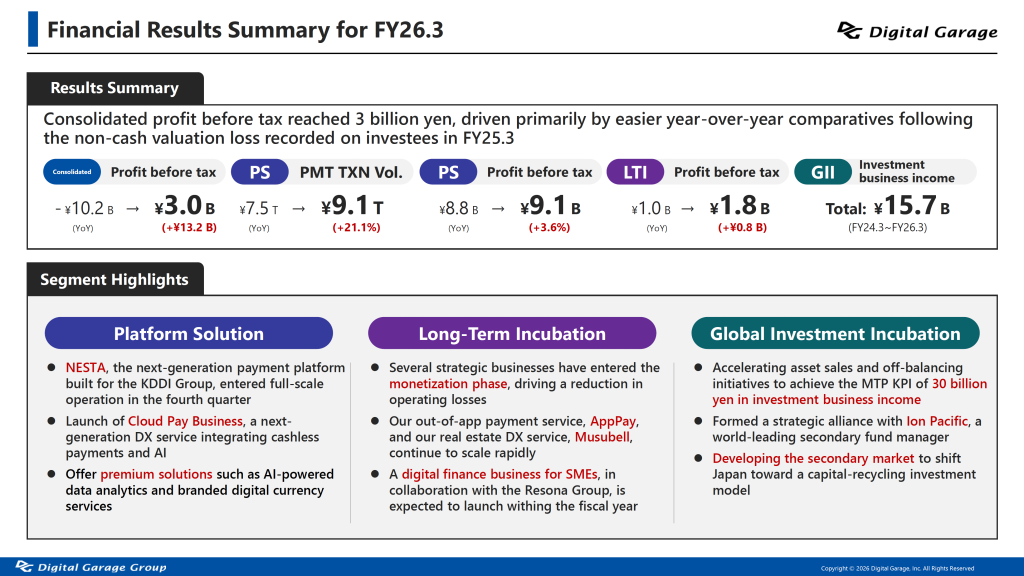
Consolidated pre-tax profit for FY26.3 was ¥3.0 billion, an increase of ¥13.2 billion from the previous fiscal year. This was mainly due to a rebound from the investment valuation losses recorded in the previous fiscal year.
In the PS segment, our financial marketing business performed steadily. However, our core payment business came in below the initial plan, and pre-tax profit growth was 3.6% year on year. We take seriously the impact of the departure of some major merchants, changes in the competitive environment, and challenges in our own organization and management structure.
At the same time, our next-generation payment platform “NESTA” for the KDDI Group launched Phase 1 as planned. We are also making steady progress on growth initiatives, including collaboration with Toshiba Tec, expansion of QR code payments, and the launch of “Cloud Pay Business,” a next-generation DX solution based on our “Cloud Pay” platform.
In the LTI segment, several strategic businesses moved into the monetization phase, and segment business losses decreased. “AppPay” is accelerating its global rollout, and “Musubell” has expanded to more than 170 companies, including major developers.
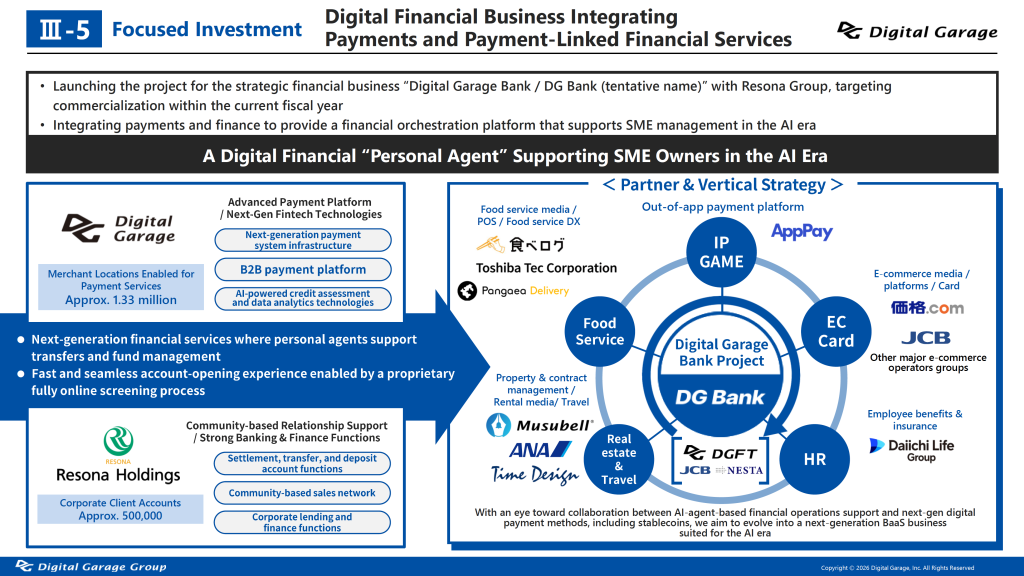
In addition, under our capital and business alliance with Resona Group, the “DG Bank Project” (tentative name) is developing a financial orchestration platform for SMEs that integrates payments, cash management, credit, and data utilization. This is a core initiative in the new “FinInfra,” which integrates payments and finance and which we see as our next growth area.
In the GII segment, we have made progress of ¥15.7 billion to date toward the current medium-term plan target of at least ¥30.0 billion in investment business income. In addition, through the strategic partnership with Ion Pacific announced today, we expect to accelerate off-balance-sheet transactions and shift to a capital recycling model, enabling earlier achievement of this target.
The key point of this partnership is not simply selling investment assets. It is to reduce earnings volatility caused by fair value changes in investment securities and foreign exchange fluctuations, and to move to a more stable business foundation. This will allow us to focus management resources more on our core areas, including payments, finance, data, and AI.
Next, I will explain the progress of our current medium-term plan and our transition to a new medium-term plan.
On May 12, two days ago, we disclosed the start of a tender offer for shares of Kakaku.com by a consortium formed by EQT and Digital Garage. Today, we also announced our strategic partnership with Ion Pacific.
In other words, we are moving forward with two major initiatives at the same time: the strategic restructuring of our media business and the off-balance-sheet transformation of our investment business.
These are not simply business divestments. They are important steps for Digital Garage to move into the next growth phase.
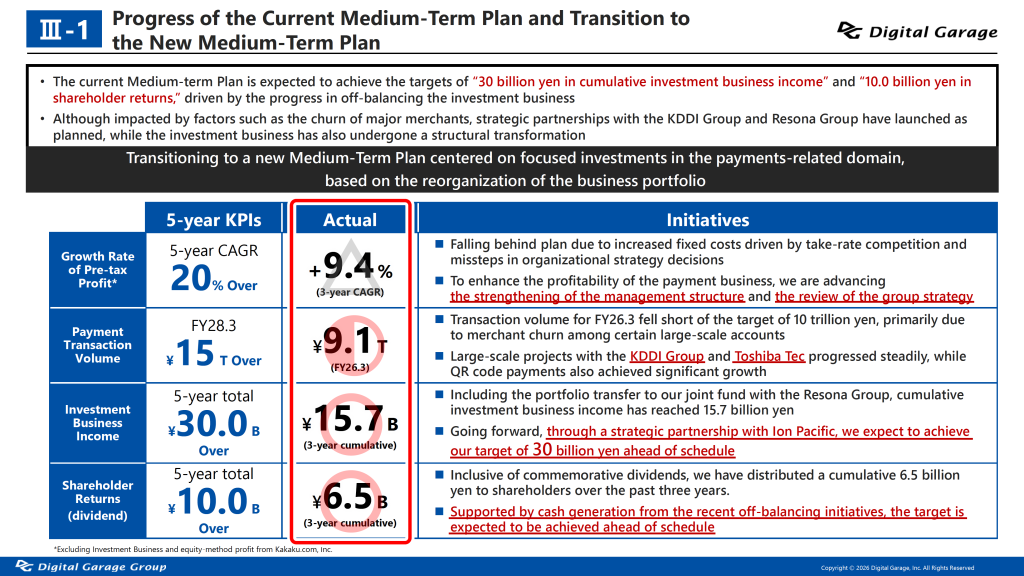
Under the current medium-term plan, we are now within reach of our targets of at least ¥30.0 billion in investment business income and at least ¥10.0 billion in shareholder returns.
At the same time, we are behind our original plan in areas such as pre-tax profit growth and payment transaction volume. To address this, we are strengthening our management structure and reviewing our group strategy to improve the earnings power of our payment business.
In the payment business, large projects for the KDDI Group and Toshiba Tec, as well as expansion of QR code payments, are progressing well. The DG Bank concept through our partnership with Resona Group has also started as planned.
In the investment business, we expect to achieve the ¥30.0 billion target earlier through the strategic partnership with Ion Pacific. In addition, by moving assets off balance sheet, we will reduce earnings volatility and transition to a more stable business foundation.
For shareholder returns, we have paid ¥6.5 billion in dividends over the past three years, including commemorative dividends. Taking into account cash generation from the off-balance-sheet transactions, we also expect to achieve the ¥10.0 billion target ahead of schedule.
In this way, not everything in the current medium-term plan has progressed exactly as planned. However, in terms of strategic restructuring of the media business, off-balance-sheet transformation of the investment business, and rebuilding our growth platform centered on payments and finance, we are steadily putting in place the foundation to transition to the next medium-term plan.
The following slides cover the progress of the current medium-term plan and the transition to the new medium-term plan.
Our direction for the new medium-term plan is clear.
Toward DG’s “second founding,” we will reorganize our business portfolio and concentrate on next-generation growth areas.
By “second founding,” we do not mean simply starting new businesses. We mean repositioning the capabilities we have built—payments, data, media, investment, and incubation—for the AI era, and moving Digital Garage to the next stage of growth.
We have organized our execution principles into four points:
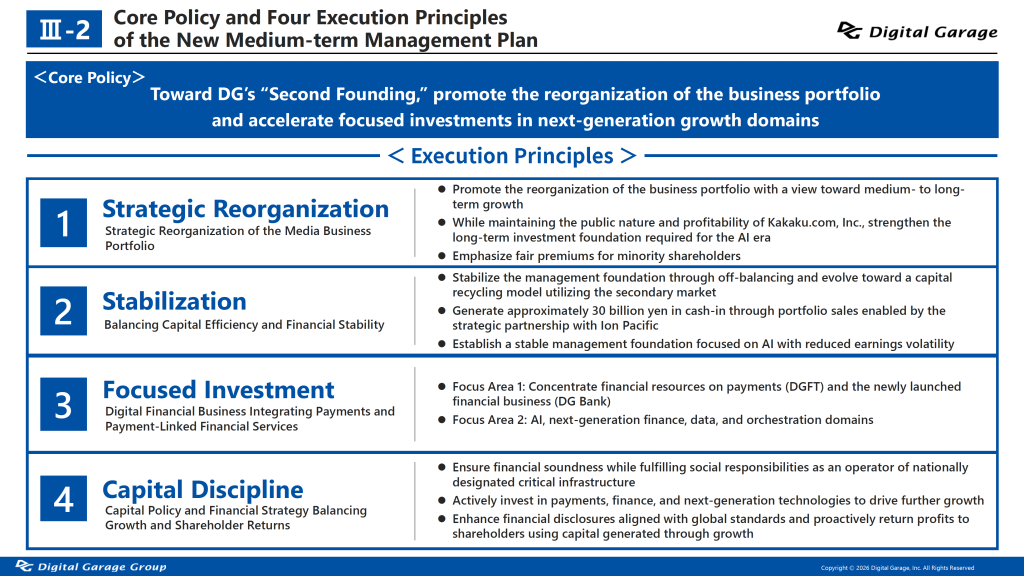
The first principle is Strategic Reorganization.
While maintaining Kakaku.com’s neutrality, public nature, and independence, we will pursue an optimal capital structure that enables long-term investment required in the AI era. This is not just a sale of our stake; it is a strategic restructuring to raise the value of the media business to the next phase. We also place importance on offering minority shareholders a fair choice based on an appropriate premium.
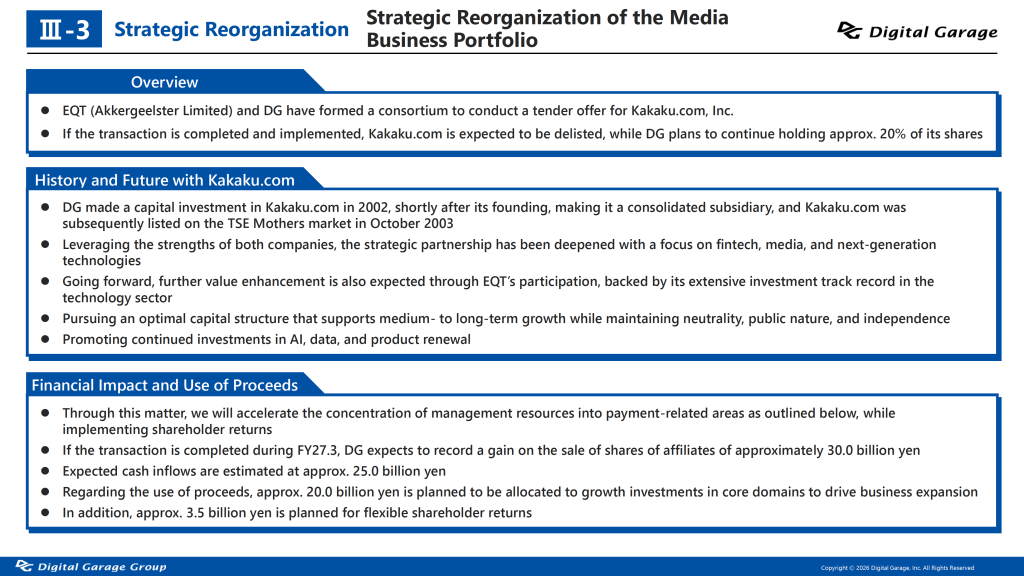
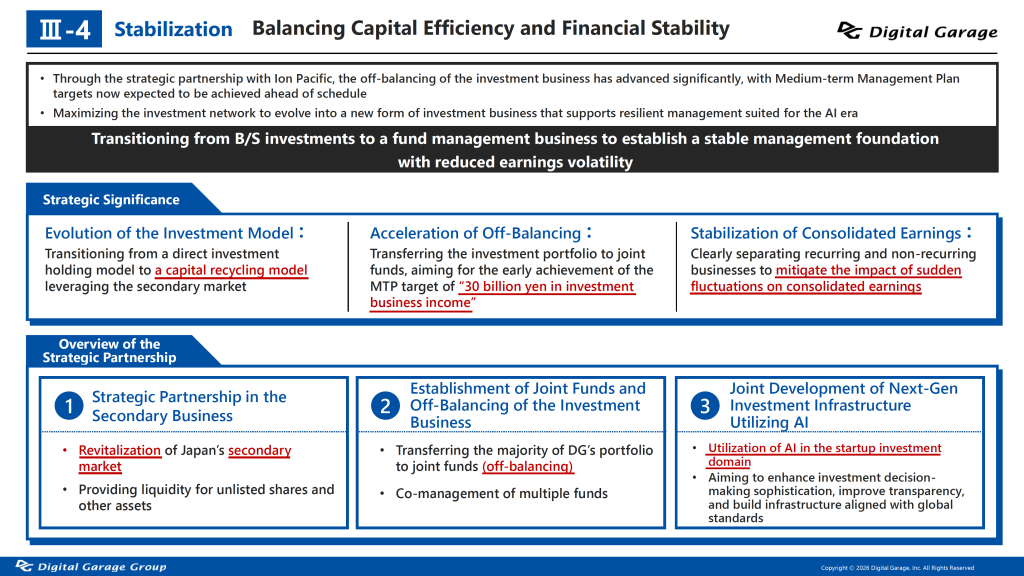
The second principle is Stabilization.
We will evolve the investment business from a direct-holding model using our balance sheet to a capital recycling model using secondary transactions and co-investment funds. This will allow us to earn investment returns while reducing earnings volatility and building a more stable business foundation.
The third principle is Focused Investment.
Centered on DGFT and our payment business, and through the DG Bank concept, we will build next-generation financial infrastructure that combines payments and finance. We will also invest in AI, data, and orchestration domain to build platforms that support DX for SMEs and across industries.
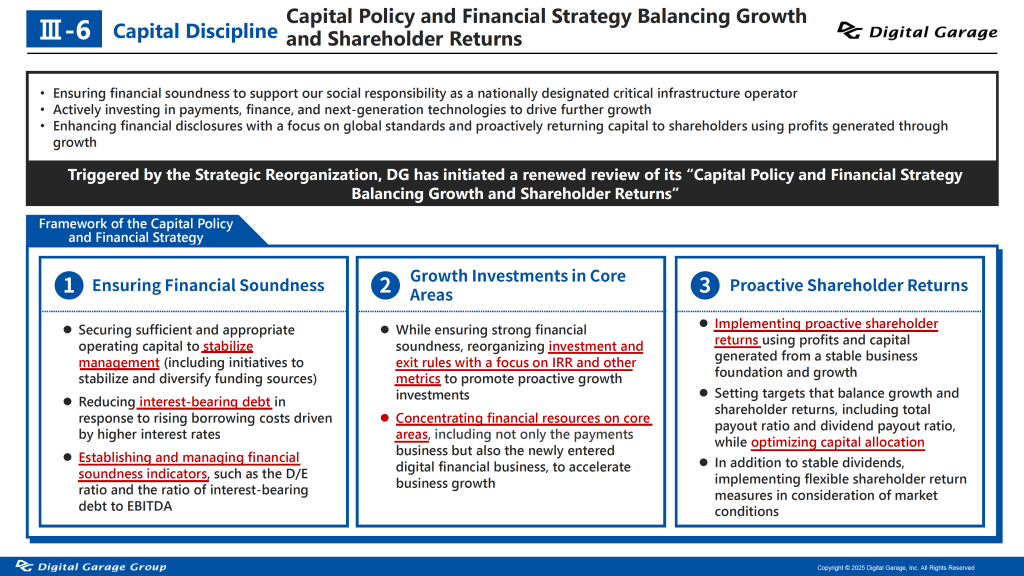
The fourth principle is Capital Discipline.
While maintaining financial soundness, we will invest for growth with IRR in mind and also execute shareholder returns flexibly. Our policy is to balance growth investment, financial stability, and shareholder returns under disciplined capital allocation.
These four principles are not separate initiatives.
Strategic restructuring of Kakaku.com will strengthen the long-term growth base of the media business. The partnership with Ion Pacific will move the investment business off balance sheet and stabilize our business foundation. Then we will concentrate capital and management resources into payments, finance, and AI/data, including DG Bank.
This is our basic thinking as we move toward the new medium-term plan. We plan to announce our new medium-term plan during the current fiscal year.
Finally, I will explain DG Group New Context. Please take a look at the following slide.
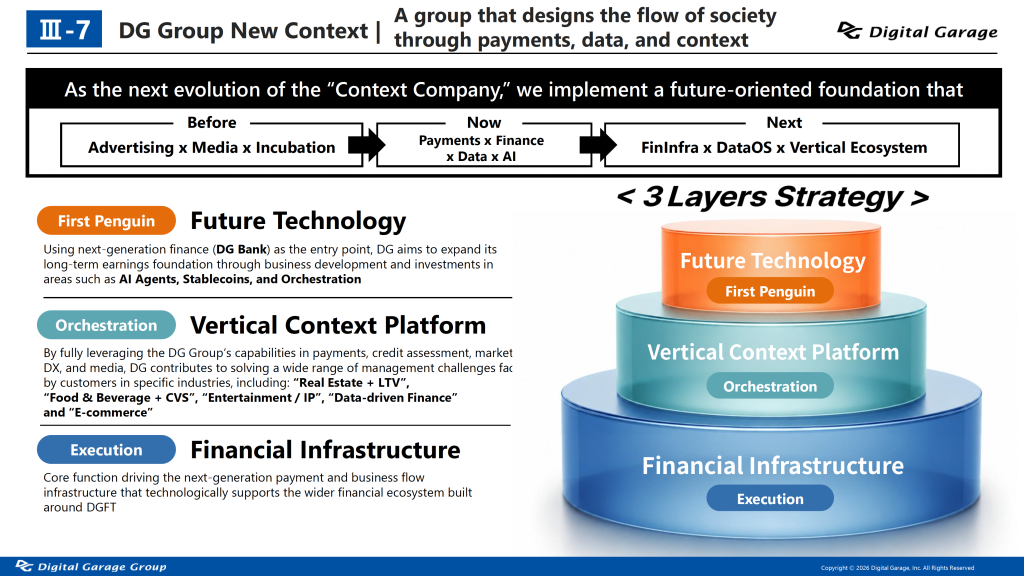
To date, guided by our vision of a “Context Company,” we have created new internet industries and communities, centered on advertising, media, and incubation.
Today, we are shifting to a phase where we support social infrastructure itself, with payments, finance, data, and AI at the core.
Going forward, Digital Garage will evolve from a group of operating companies into a corporate group that designs and supports “the flow of society”—payments, data, and the flow of commerce.
We summarize this direction in a new group concept:
FinInfra × DataOS × Vertical Ecosystem
The bottom layer is the Execution Domain / Financial Infrastructure.
This is the execution platform for payment and financial infrastructure centered on DGFT, and it provides the core functions that support commerce and money flows in society, including payments, remittance, merchant networks, B2B payments, and data processing.
The middle layer is the Orchestration Domain / Vertical Context Platform.
By combining the functions of the DG Group—payments, credit, data, DX, media, marketing, and more—we will build industry-specific platforms to solve management issues in areas such as real estate, restaurants, e-commerce, IP, and data finance.
The top layer is the First Penguin Domain / Future Technology.
We will invest in and develop future technologies and new industries such as DG Bank, AI agents, stablecoins, next-generation finance, and orchestration technologies.
Digital Garage has always challenged the near future a little ahead of others. Going forward, we will grow through a three-layer structure: a stable financial infrastructure as the foundation, vertical platforms on top, and continuous challenges in next-generation technologies above that.
This update to our medium-term plan is not just a revision of a business plan.
It is a new blueprint for Digital Garage to evolve over the next decade into a corporate group that supports the flow of society, centered on payments, data, finance, and AI.
We will continue working to enhance corporate value over the medium to long term, and we appreciate your continued support.